Ernie Holm
The World According to GarpErnie Holm is a former champion wrestler, high-school coach, and devoted single father who becomes the Steering School wrestling coach and an important friend to Jenny Fields and her family. His story brings together the discipline of the wrestling room and the unfinished history of his own family: he understands boredom and loneliness, makes room for difficult stories, and offers a model of patient care that Garp later honors by succeeding him as coach.
Identity and Background
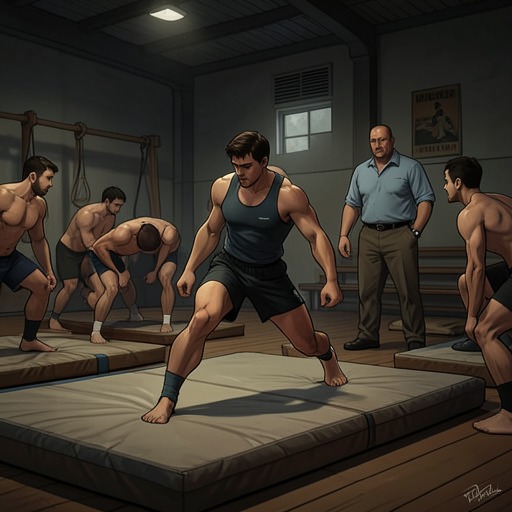
Ernie arrives at Steering after fifteen years of coaching high schools across Iowa. At the University of Iowa he had been a two-time Big Ten wrestling champion, though he never won a national title. He has spent those years raising his only child, Helen, by himself, and comes east to give her what he regards as a more sophisticated education. His affectionate pride in her is plain: he calls her the brains of the family and privately admires her looks, which remind him of her absent mother.
The move also reflects Ernie’s weariness with the Midwest and his first impressions of Steering. He finds the local community as snobbish as Jenny does. The wrestling room, however, is a place where he feels entirely at ease. Wrestling is not merely his profession there; it is the setting in which he can speak naturally, even about the most difficult parts of his life.
Fatherhood and the Family Story
Helen’s mother was a nurse. After Helen was born, she gave up nursing to become a full-time parent, but within six months she wanted to return to work. With no day-care centers available in Iowa at the time, the strain of full-time motherhood and life outside nursing gradually distanced her from Ernie. One day she left, giving him no explanation and leaving him to raise Helen alone. Ernie made no attempt to find her.
Helen nevertheless remains watchful for nurses, hoping in some way to encounter her vanished mother. When she was young, Ernie gave her an imagined possibility rather than a promise: perhaps Helen might one day meet a pretty nurse who seemed lost, and who might be curious about Helen too. That speculative story stays with Helen. It reveals Ernie’s willingness to meet a child’s unanswered questions with tenderness, even when he cannot provide an ending.
Ernie is particularly sensitive to people who are bored. When Jenny and Helen wait for him to explain why he has ended wrestling practice, he first sends the team out to run laps. Then, in the room where he feels most at home, he patiently tells Jenny and Helen the story of his daughter, the nurse who left, and the Midwest they have recently left behind. It is a story without resolution, but his act of telling makes space for the loss rather than disguising it.
Jenny Fields and the Holm Family
Ernie’s openness helps establish his friendship with Jenny. He may briefly imagine a deeper life with her, but Jenny does not share that desire: she sees him as a good and kind man and hopes he might become her friend. The distinction matters. Their connection grows from companionship and trust, not a romance, and Ernie becomes one of the first people Jenny can regard as a friend.
Their friendship sits alongside Jenny’s lasting role as a nurse. In Garp’s view, she nurses him through school, helps women facing difficult choices after the success of her book, and offers care as a central part of her life. Ernie’s attentiveness to boredom and loneliness makes him a natural presence in the same wider network of care, though the two express it differently: Jenny tends through direct practical attention, while Ernie listens and tells stories.
Ernie also remains connected to Helen and Garp through the ordinary continuities of family life. He and Garp make a winter trip together to attend a major wrestling match in Iowa. As Helen’s father and Garp’s father-in-law, he is close enough that a possible phone call from him gives Garp a momentary twinge; Garp knows Ernie has a habit of apologizing too much, which embarrasses him. The detail conveys affection without making their relationship solemn: Ernie is a loved family member whose modest manners can also exasperate those who know him.
Coach, Mentor, and Legacy
The wrestling room remains Ernie’s defining workplace and a place where he can communicate beyond the routines of coaching. He is careful with the people around him, from sending wrestlers off before telling a personal story to recognizing the need for conversation rather than mere distraction. His influence is not presented as a grand declaration; it accumulates through the steady work of teaching, fatherhood, and friendship.
Ernie’s death comes suddenly. Dean Bodger tells Garp that Ernie has died, and Garp imagines the circumstances in which he was found. The novel relates the episode through Garp’s imagination and recollection of an old joke from his Steering days, while Bodger has discreetly covered Ernie and concealed the magazine from Helen. The death is followed by a family funeral, remembered alongside the anniversary of Jenny’s murder and Stewart Percy’s funeral.
Afterward, Garp offers himself as Ernie’s replacement in the Steering athletic department. He says that money does not matter and that he wants only to coach wrestling. The school accepts that he can do the job; without a replacement, a program that had been strong would begin to decline. Garp’s choice is both practical and personal: taking the position keeps the wrestling program alive and gives concrete form to his attachment to the coach who had become his father-in-law and friend.
Continuing Presence
Ernie’s legacy persists in the institution he served and in the family relationships that outlast him. Garp’s return to coaching ties his own life to Ernie’s work, while Helen’s later account of how she wants to be remembered returns explicitly to her father. She tells Donald Whitcomb that her gravestone should identify her as Helen Holm, daughter of the wrestling coach Ernie Holm, and note that she had not been allowed to attend Steering School because she was a girl. In the contrast she draws with Garp, whose grave is in the school cemetery because he was a boy, Ernie’s identity remains bound to the school and to the gendered limits that shaped Helen’s life.
Ernie is therefore more than a coach in Garp’s history. His story of abandonment gives Helen a way to imagine her mother’s possible return; his friendship offers Jenny companionship without demanding intimacy; and his work creates a role Garp chooses to carry forward. His character is defined by these acts of patient attachment, while his sudden death leaves others to preserve the relationships and institutions he helped sustain.